20 Rope Patterns for Nautical Design
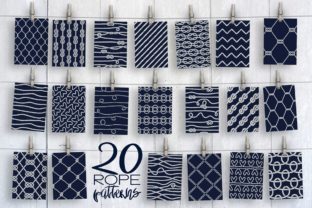
If you're drawn to the timeless charm of maritime style—think weathered docks, coiled rigging, and classic sailor motifs—you’ll love this curated set of 20 Rope Patterns. These aren’t generic digital repeats. Each one is hand-drawn with care, capturing the organic texture, subtle irregularities, and gentle tension of real rope. You’ll find tight knots, soft loops, rhythmic waves, and interwoven spirals—all designed to evoke the sea without feeling cliché.
What Makes These Patterns Stand Out?
Unlike mass-produced seamless tiles, these patterns retain the warmth of human touch. The lines have slight variations in weight and flow, making them feel authentic—not sterile or overly symmetrical. That’s especially valuable if you’re designing something meant to feel grounded, tactile, or artisanal. Whether it’s a logo for a coastal café, a textile repeat for linen napkins, or a background for a boutique packaging suite, these patterns add character without overwhelming.
They’re also thoughtfully delivered in multiple formats—so you’re never locked into one workflow. Vector files (.AI and .EPS10) let you scale infinitely or recolor on the fly. PNGs come at high resolution (5000×5000 px, 300 dpi) with full transparency, so you can drop them onto any background—sand-colored walls, deep navy cards, or even gradient overlays—without extra editing.
Where You’ll Actually Use Them
Let’s talk real-world use—not just “great for design.” A small-batch candle maker might wrap jars with kraft paper stamped using a loop-based pattern, giving each label a hand-finished nautical rhythm. A freelance graphic designer could build a brand identity for a sailing school using one of the knot motifs as a subtle watermark behind course materials. A home decorator might layer a wavy rope pattern as a wallpaper accent behind a built-in bookshelf—soft enough to recede, strong enough to anchor the space.
Apparel designers appreciate how easily these translate to fabric prints: a subtle rope repeat works beautifully on cotton tees or linen shirts, while bolder knot patterns shine on tote bags or beach towels. Educators teaching marine biology or local history sometimes use them in classroom posters or presentation decks—adding visual cohesion without distracting from content. Even bloggers covering coastal travel or sustainable living use them to unify their social media templates or email headers.
Easy Customization, No Expertise Required
You don’t need to be a vector wizard to adapt these. If you’re comfortable dragging a file into Canva or Photoshop, you’re already set. Want that deep blue background swapped for seafoam green? Open the PNG in your editor, place it over your new color, and adjust opacity or blending mode if needed. Prefer crisp edges and editable strokes? Open the .AI or .EPS10 file in Illustrator—select any shape, change its fill, or tweak anchor points to fine-tune spacing or density.
Each vector file contains five patterns across separate artboards—no hunting through layers or guessing which version is which. That means faster testing: try Pattern #3 on a business card, then swap to Pattern #7 for a web banner—all within the same document.
Why This Collection Fits Real Creative Needs
Many nautical assets lean too literal—anchors, ships, or seagulls—that quickly date or limit versatility. These 20 Rope Patterns avoid that trap. They’re abstract enough to work across industries but evocative enough to signal “coastal,” “craft,” or “adventure” in seconds. They support goals like building brand consistency, elevating handmade product photography, or adding quiet sophistication to minimalist layouts.
They’re also inclusive in scope. Beginners get plug-and-play files with no setup headaches. Seasoned designers get clean vectors they can modify, combine, or integrate into larger systems. Small business owners get commercial-use rights—no hidden restrictions—so whether you’re selling printed stationery or licensing a fabric line, you’re covered.
Things to Keep in Mind Before You Start
- Resolution matters for print: All JPG and PNG files are 5000×5000 px at 300 dpi—ideal for large-format printing like banners or wall decals. For tiny applications (like embroidery digitizing), you may want to simplify or trace key shapes first.
- Transparency isn’t always automatic: While all PNGs include alpha channels, some older software may default to white backgrounds. Double-check your import settings—or open the file in Preview (Mac) or Photos (Windows) first to confirm transparency is intact.
- Vector files require compatible software: .AI files work best in Adobe Illustrator CC 2019 or newer; .EPS10 is widely supported but may render slightly differently in non-Adobe apps. If you only use Affinity Designer or Figma, the PNGs give you identical visual quality with more flexibility.
- Patterns behave differently across surfaces: A tight knot repeat may read clearly on fabric but feel busy on a website header. Test at actual size—and consider scaling down density or increasing spacing when adapting for digital screens.
Simple Ideas to Try This Week
- Open one of the transparent PNGs and overlay it on a photo of your workspace—see how it adds texture without hiding details.
- Import a vector file into Illustrator, select three patterns, and create a custom swatch library for quick access in future projects.
- Print a few patterns at 8×10” on matte cardstock, cut them into strips, and use them as gift wrap accents—no tape needed, just a simple knot or tuck.
- Use a wavy rope pattern as a subtle border in a newsletter template—just along the top or bottom edge—to reinforce theme without shouting it.
Whether you’re sketching your first logo or refining a decade-old brand, these 20 Rope Patterns offer flexibility, authenticity, and quiet confidence. They don’t shout “nautical”—they whisper it, elegantly, and leave room for your voice to lead.