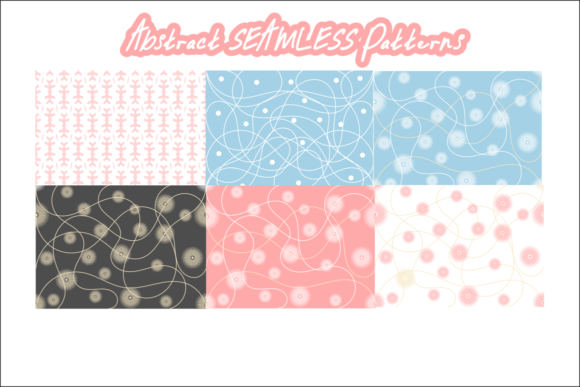
Abstract Seamless Patterns: The Invisible Architecture Behind Modern Surface Design
At first glance, abstract seamless patterns may seem like background noise—repetitive motifs fading into the periphery of visual culture. Yet beneath their quiet repetition lies a foundational design logic that powers everything from high-fashion textiles to digital interfaces, packaging, and even architectural cladding. Unlike traditional prints anchored by literal imagery or historical motifs, abstract seamless patterns operate through rhythm, scale, contrast, and spatial tension—generating visual interest without relying on narrative or representation. Their “seamlessness” isn’t just technical; it’s experiential—a continuous field that invites the eye to wander, loop, and reinterpret across surfaces of any dimension.
What Makes a Pattern Truly Seamless—and Why Abstraction Elevates It
A seamless pattern repeats flawlessly both horizontally and vertically, with no visible breaks, offsets, or mismatched edges. Technically, this requires precise alignment of tile boundaries—where the right edge of one unit meets the left edge of the next, and the top aligns perfectly with the bottom. But seamlessness is more than pixel-perfect tiling: it’s about perceptual continuity. An effective abstract seamless pattern avoids focal anchors—no central motif, no directional hierarchy—so the viewer’s attention doesn’t snag. Instead, it sustains flow through subtle shifts in density, tone, or line weight.
Abstraction amplifies this effect. When forms are non-representational—think gestural strokes, organic blots, geometric fractures, or layered transparencies—the brain doesn’t pause to decode meaning. This frees perception to engage with texture, rhythm, and scale. For instance, a pattern built from overlapping translucent circles creates depth through opacity gradients rather than perspective; a composition of intersecting angular vectors generates kinetic energy without implying motion. These qualities make abstract seamless patterns suitable for t-shirt and dress designs not because they’re trendy, but because they adapt intelligently to the human form—wrapping around shoulders, cascading down skirts, or compressing across elbows without visual disruption.
Real-World Applications Across Industries
The versatility of abstract seamless patterns emerges most clearly when observing how different sectors deploy them—not as decoration, but as functional language.
- Fashion & Apparel: Designers use abstract seamless repeats to unify collections without monotony. A single pattern can scale from micro-dot on silk scarves to macro-fracture on oversized denim jackets—same underlying structure, radically different impact. Because these patterns lack literal subject matter, they sidestep cultural misinterpretation and age gracefully across seasons. Brands like COS and A-COLD-WALL* rely heavily on such systems to maintain minimalist rigor while avoiding sterility.
- Interior Surfaces: Wallpaper, tiles, and upholstery benefit from abstraction’s neutrality. A softly blurred gradient repeat works equally well behind a bookshelf or across an entire accent wall—its lack of “subject” prevents visual competition with furniture or art. In commercial spaces, such patterns reduce cognitive load in waiting areas or lobbies, supporting calm without sacrificing sophistication.
- Digital Products: UI designers embed abstract seamless textures as subtle backgrounds in dashboards and apps—low-saturation noise layers or fine-line grids add tactility without interfering with readability. Unlike photographic textures, abstract repeats scale infinitely across responsive layouts, eliminating stretch artifacts or resolution drop-offs.
- Packaging & Branding: When applied to product boxes or labels, these patterns serve dual roles: aesthetic cohesion and tactile suggestion. A matte-finish pattern with micro-embossed geometry implies craftsmanship; a watercolor-style abstract repeat signals artisanal origin—even before the consumer reads a word.
Why T-Shirt and Dress Designers Prioritize Abstract Seamless Repeats
Garment design presents unique physical constraints that make abstract seamless patterns suitable for t-shirt and dress designs especially valuable. Fabric stretches, folds, and drapes unpredictably. A floral print with defined stems may distort unattractively at the underarm seam; a landscape motif risks truncation at the hem. Abstract patterns avoid these pitfalls entirely.
Consider three practical advantages:
- Scale Flexibility: A designer can generate one vector-based abstract repeat and output it at 50% scale for a children’s tee or 300% for a floor-length gown—all while preserving clarity and proportion. No re-drawing. No loss of fidelity.
- Seam Integration: Because there’s no “up” or “down,” pattern orientation becomes fluid. A dressmaker can rotate the fabric layout to minimize waste or align repeats across front/back panels without worrying about upside-down motifs or misaligned horizons.
- Colorway Agility: Abstract structures separate form from hue. A single line-based pattern can be rendered in monochrome charcoal, neon cyan/orange duotones, or earthy ochre/umber—each evoking distinct moods without altering the core design file.
This agility translates directly to production efficiency. Print-on-demand services, small-batch studios, and sustainable fashion labels all benefit from reduced file management overhead and faster prototyping cycles.
Key Characteristics That Define High-Performing Abstract Seamless Patterns
Not all abstract repeats function equally well across applications. The most effective ones share observable traits—grounded in visual psychology and material behavior.
Controlled Complexity: The strongest patterns balance variation with restraint. Too little differentiation between elements feels static; too much creates visual noise. A successful example might layer three rhythmic components: a dominant base shape (e.g., soft-edged hexagons), a secondary overlay (fine intersecting lines), and a tertiary texture (subtle grain). Each operates at a distinct scale and opacity, creating depth without clutter.
Edge Integrity Without Obviousness: Seamless tiling must hide its seams—but not through invisibility alone. The best patterns use deliberate “edge strategies”: mirrored gradients, interlocking contours, or staggered transparency that guides the eye across boundaries rather than stopping it. You don’t notice the seam because the pattern *invites* continuation.
Material-Aware Contrast: What reads as elegant subtlety on cotton jersey may vanish on reflective polyester or appear harsh on unbleached linen. High-performing abstract seamless patterns anticipate substrate behavior. Designers often build variants: one optimized for direct-to-garment ink absorption (with slightly increased contrast), another calibrated for sublimation on synthetic fabrics (emphasizing midtone separation).
Practical Considerations for Creators and Buyers
Whether you’re commissioning, licensing, or creating abstract seamless patterns, awareness of technical and contextual factors prevents costly revisions or mismatched expectations.
For independent designers: Start with tile size intentionality. A 12×12 inch repeat suits most apparel printers, but if targeting home décor mills, 24×24 or larger may be required. Always export source files in vector (SVG/EPS) plus high-res TIFF/PNG—never JPEG, due to compression artifacts that corrupt seamless edges.
For small businesses sourcing patterns: Verify licensing scope. Some marketplaces grant “standard” licenses covering up to 500 physical units—insufficient for scalable apparel brands. Look for extended or unlimited commercial licenses, and confirm whether derivative works (e.g., recoloring or combining with other assets) are permitted.
For educators and students: Use abstract seamless creation as a gateway to teaching core principles—grid systems, color theory in context, and the mathematics of tessellation. Assign exercises where students deconstruct existing patterns (e.g., from museum textile archives) to reverse-engineer tile boundaries and identify repetition logic. This builds analytical muscle beyond software proficiency.
For researchers studying visual cognition: Abstract seamless fields offer rich terrain for investigating peripheral processing and attentional persistence. Unlike framed images, seamless patterns lack entry/exit points—making them ideal stimuli for measuring how long viewers sustain engagement without conscious effort. Recent studies at the Max Planck Institute have correlated specific frequency ranges in abstract repeats with measurable reductions in blink rate, suggesting deeper perceptual immersion.
Emerging Trends Shaping the Future
Three developments are quietly reshaping how abstract seamless patterns evolve:
- Generative Constraints: Designers increasingly use algorithmic tools—not to auto-generate patterns, but to impose intelligent limits. For example, defining maximum edge variance (±3px) or mandating minimum spacing between similar shapes ensures technical reliability before aesthetic refinement begins.
- Tactile Translation: As 3D-printed textiles and embossed finishes gain traction, patterns are being designed with haptic feedback in mind. Lines aren’t just visual—they’re calibrated for raised height (0.15mm), width (0.3mm), and spacing to create legible texture under fingertips.
- Eco-Material Responsiveness: With organic cotton, Tencel, and recycled poly gaining dominance, new pattern libraries account for fiber behavior—building in slight tonal shifts to compensate for natural dye lot variation, or adjusting contrast thresholds for lower-impact pigment systems.
Ultimately, abstract seamless patterns endure not as stylistic choices, but as structural solutions—quietly enabling clarity, consistency, and creativity across disciplines. They ask little of the viewer and deliver much: cohesion without cliché, repetition without redundancy, and surface intelligence that adapts—seamlessly—to every context it meets.