Geometric Patterns: Seamless Vector Resources for Design, Education, and Innovation
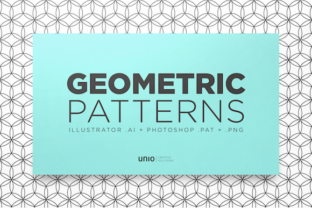
Geometric Patterns represent one of the most enduring and versatile visual languages in human expression—from ancient mosaics and Islamic tilework to modern UI interfaces and generative art. Their precision, scalability, and mathematical coherence make them indispensable across disciplines. This collection of 20 seamless vector patterns offers a rigorously crafted foundation for professionals and learners alike, delivered in industry-standard formats: .ai (Adobe Illustrator CC 2021+), .pat (Photoshop pattern swatches), .png (high-resolution, transparent-background raster at 300 DPI), and .eps (Encapsulated PostScript, compatible with legacy and vector-focused workflows).
Why Seamless Vector Patterns Matter Beyond Aesthetics
Seamless patterns aren’t just decorative—they’re functional tools engineered for repetition without visible seams or distortion. Unlike tiled bitmap images that pixelate or misalign, vector-based geometric patterns retain infinite scalability and crisp fidelity at any size. This isn’t merely convenient; it’s operationally critical when designing for variable outputs: a logo applied to a business card, a billboard, and a fabric swatch must behave consistently. Each pattern in this set is constructed using anchor-point precision, uniform stroke weights (where applicable), and mathematically verified tiling boundaries—ensuring reliability whether imported into Figma for prototyping or embedded into a CNC engraving workflow.
Consider an educator preparing materials on symmetry and tessellation. A static image of a hexagonal grid limits interactivity—but a native .ai file allows students to isolate individual rhombi, recolor paths, or animate rotational transformations. Similarly, a textile designer developing a repeat for digital loom programming requires .pat files that render accurately under Photoshop’s pattern fill engine—no manual offset correction needed. These aren’t “plug-and-play” graphics; they’re interoperable components calibrated for real-world constraints.
Design & Branding
Geometric Patterns serve as structural anchors in visual identity systems. A subtle triangular mesh can reinforce a tech brand’s emphasis on precision and connectivity; concentric circles may echo concepts of growth and inclusivity in nonprofit communications. Because these patterns are vector-based, designers can adjust hue, saturation, and contrast non-destructively—applying global color themes across presentations, websites, and merchandise without re-exporting assets. The inclusion of .png variants supports rapid web integration where SVG support is limited (e.g., email templates or legacy CMS platforms), while retaining transparency for layered compositions.
Architecture & Interior Visualization
Architectural visualization studios use seamless patterns to simulate materiality—concrete textures, perforated metal screens, acoustic panel layouts—without bloating file sizes. Unlike high-res photographic textures, vector patterns scale cleanly in orthographic views and perspective renders alike. A parametric facade study might overlay a Voronoi-derived pattern (included in this collection) onto a façade model to assess solar shading performance. Because the pattern is vector-based, it remains editable within Revit via linked DWG imports or Rhino via Grasshopper data trees—enabling iterative testing of density, rotation, and spacing.
Education & STEM Pedagogy
In classrooms, Geometric Patterns bridge abstract mathematics and tangible observation. Teachers use the .eps files—which preserve vector integrity across open-source tools like Inkscape and LibreOffice Draw—to illustrate translational symmetry, glide reflections, and wallpaper group classifications (p1, p2, pm, etc.). Students can import a pattern, measure internal angles of repeating polygons, or export coordinate data for computational analysis. One educator in Portland reported using the dodecagonal tiling variant to introduce modular arithmetic through vertex labeling—transforming a visual motif into a scaffold for number theory reasoning.
Product Development & Manufacturing
For industrial designers and product engineers, seamless vector patterns integrate directly into CAD environments. Laser-cut packaging prototypes benefit from dot-matrix or grid-based alignment guides embedded as vector layers beneath structural lines. The .ai format supports direct copy-paste into Fusion 360 sketches, while .eps files remain compatible with CAM software that ingests PostScript for toolpath generation. A small-batch ceramics studio in Asheville uses the staggered diamond pattern to calibrate slip-casting mold textures—scaling the vector precisely to match kiln shelf dimensions before CNC milling.
Format-Specific Advantages and Workflow Integration
Each included format serves distinct technical needs—not redundancy:
- .ai files are fully editable in Adobe Illustrator: paths, gradients, and layer structure remain intact. Designers can extract individual motifs, modify corner radii, or convert strokes to outlines for laser-cutting prep—all without quality loss.
- .pat files load instantly into Photoshop’s pattern library (Edit > Presets > Preset Manager > Patterns). They function natively with layer blending modes, masks, and smart objects—ideal for mockups, texture overlays, and non-destructive compositing.
- .png files provide immediate usability across platforms lacking vector support: Canva, Google Slides, Microsoft PowerPoint, or basic HTML/CSS backgrounds. At 300 DPI and transparent background, they retain print readiness and responsive scaling via CSS
background-size: cover. - .eps files ensure backward compatibility with pre-CC Adobe applications, CorelDRAW, and scientific illustration tools like OriginLab or GraphPad Prism. Their device-independent PostScript encoding guarantees consistent rendering across RIP (raster image processor) workflows used in commercial printing.
This multi-format strategy reflects how professionals actually work—not in silos, but across overlapping tools. A marketing team might begin with a .pat file for social media banners in Photoshop, then switch to the .ai version to adapt the same pattern for a trade show backdrop in Illustrator, and finally embed the .png into their WordPress site header—all while preserving visual continuity.
Key Characteristics That Define Quality in Geometric Pattern Collections
Not all geometric patterns deliver equal utility. These 20 were curated—and in many cases, algorithmically validated—for five measurable attributes:
- Tiling Integrity: Every pattern was tested across 4×4 tile repetitions in Illustrator’s Pattern Options panel and manually verified for seamlessness in both horizontal and vertical axes. No hidden offsets or floating anchor points.
- Minimal Anchor Count: Paths use the fewest necessary Bézier points—reducing file bloat and improving rendering speed in complex documents. The minimalist triangle lattice contains under 30 anchor points per tile unit.
- Consistent Stroke Behavior: Where strokes appear (e.g., in linear grids or intersecting line patterns), they adhere to uniform weight and cap/join settings—ensuring predictable output whether exported to PDF/X-4 or sent to a vinyl cutter.
- Neutral Color Base: All vector files ship in grayscale or black-only mode. This avoids unintended color shifts during CMYK conversion and simplifies global recoloring via Illustrator’s Recolor Artwork tool or CSS variables.
- Real-World Proportions: Tile dimensions reflect practical use cases—e.g., the hexagonal pattern measures 240×207.8 px (matching a standard 1:√3 ratio), making it directly usable in CSS
repeating-linear-gradientfallbacks.
Practical Considerations When Implementing Geometric Patterns
Even high-quality resources require thoughtful deployment. Three recurring considerations emerge across user feedback:
First, scale context matters. A pattern optimized for fabric repeat (e.g., 24-inch square) behaves differently when scaled to 24-pixel web tiles. Always verify tiling behavior at your target output size—especially when converting vectors to raster for mobile interfaces. The .png files included here were generated at multiple resolutions (1x, 2x, 3x) specifically to address this.
Second, color interaction is non-linear. Overlapping semi-transparent geometric layers can produce unexpected moiré effects or optical vibration. Test patterns against intended backgrounds—particularly with high-contrast combinations like neon green on black. The grayscale base of these vectors gives users full control over luminance relationships.
Third, licensing scope affects implementation. These patterns are licensed for unlimited commercial use—including client work, SaaS dashboards, and physical product decoration—but exclude resale as standalone pattern libraries or NFT collections. This aligns with professional ethical standards: supporting creators while enabling broad application.
Emerging Trends Reinforcing the Value of Precision Geometric Systems
Three converging developments underscore why rigorously built Geometric Patterns are gaining renewed relevance:
Generative design workflows increasingly rely on vector primitives as input for AI-assisted iteration. Tools like Galapagos (within Grasshopper) or custom Python scripts use clean path data to evolve pattern density, curvature, or adjacency rules—something noisy or raster-based inputs cannot support reliably.
Accessibility standards now extend to texture cognition. WCAG 2.2 draft guidelines emphasize predictable spatial relationships for users navigating via screen readers or tactile maps. Consistent, logically structured geometric systems—like the orthogonal grid or radial concentric sets in this collection—provide clearer spatial anchors than organic or irregular motifs.
Finally, sustainability-driven design favors vector over photographic textures. A single .ai file replaces dozens of high-res JPEGs previously used for “concrete,” “marble,” or “fabric” simulations—reducing bandwidth, storage, and energy consumption across digital supply chains.
Whether you're drafting lesson plans on Euclidean geometry, specifying surface finishes for a public transit hub, or prototyping a wearable interface with haptic feedback zones, these 20 seamless vector patterns offer more than visual appeal. They provide a shared, scalable, and semantically coherent language—one grounded in measurement, repeatability, and cross-platform fidelity. Their value lies not in novelty, but in quiet reliability: the kind that lets educators teach, designers ship, and researchers analyze—without wrestling with broken tiles or blurry edges.