Paisley Patterns Collection: Timeless Design, Modern Flexibility
There’s a reason paisley has endured for centuries — from Mughal shawls to 1960s rock posters, its swirling teardrop motif carries rhythm, richness, and quiet sophistication. But today’s designers don’t just want heritage — they need precision, scalability, and seamless integration into digital and physical workflows. That’s where the Paisley Patterns Collection delivers something rare: traditional harmony paired with technical readiness.
More Than Just Pretty Repeats
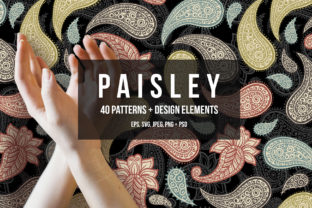
This isn’t a grab-bag of decorative motifs. The Paisley Patterns Collection is built for real-world use — whether you’re developing textile lines, crafting packaging, designing apparel, or building web interfaces with patterned backgrounds. At its core are 40 seamless patterns, each thoughtfully composed to tile flawlessly across any surface. No visible seams. No awkward breaks. Just fluid, repeatable elegance.
What makes these patterns truly versatile is their format diversity. You’ll receive:
- 10 high-resolution JPEGs (6000×6000 px, 300 dpi) — ideal for print mockups, fabric swatches, or large-format presentations;
- 10 editable EPS files — perfect for tweaking scale, color, or spacing in Adobe Illustrator without quality loss;
- 10 SVG files — lightweight, responsive, and ready for web use, embroidery software, or cutting machines;
- 10 PNGs on transparent background (6000×6000 px, 300 dpi) — essential for layering over photos, UI elements, or product renders.
Need smaller dimensions? Resize confidently — all raster files are built at high resolution so scaling down to 3000×3000 px retains crispness for most commercial print needs.
Design Elements That Build, Not Just Decorate
A great pattern library doesn’t stop at repeats. The Paisley Patterns Collection includes 41 individual design elements — standalone paisleys that function as building blocks. Think of them as your visual vocabulary: mix, rotate, recolor, scatter, or align them into custom layouts, borders, monograms, or branding assets.
You get three distinct variations of black-outline paisleys:
- 11 vector EPS files — fully editable in Illustrator (change stroke weight, convert to shapes, adjust anchor points);
- 11 high-res JPEGs (6000×6000 px, 300 dpi) — ready for quick placement in Photoshop or InDesign;
- 16 PNGs on transparent background (300 dpi, 6000×6000 px) — drop them anywhere without clipping masks or background cleanup.
Plus, there’s a layered PSD file (8671×7140 px, 600 dpi) containing all black-outline paisleys — organized by size and style, with layers named and grouped logically. It’s like having a designer’s toolkit pre-sorted and labeled.
And because contrast matters, the collection also includes a White Outline Paisleys Set: one editable EPS file and one high-res JPEG (6000×6000 px, 300 dpi). Use them for light-on-dark applications — think embroidered logos on navy denim, foil-stamped stationery, or subtle overlays on dark-mode UIs.
Why Format Variety Isn’t Optional — It’s Essential
In modern design, one file type rarely fits all. A textile mill needs vector EPS for loom programming. A t-shirt printer needs high-res PNGs with transparency. A web developer wants SVG for retina displays and fast loading. A packaging designer might need JPEGs for CMYK proofing in Adobe Acrobat.
The Paisley Patterns Collection anticipates those needs. SVG ensures sharp rendering at any screen size — no pixelation on mobile or 4K monitors. EPS preserves editability for production teams who tweak spacing or adapt motifs to fit garment panels. PNGs give instant drag-and-drop flexibility in presentation tools like Keynote or Figma. And JPEGs remain the universal standard for client approvals and physical proofs.
This breadth means you’re never stuck converting or compromising. No more tracing low-res scans. No more begging your printer to “just make it work.” You start with what you need — and move forward.
Fabrics, Fashion & Beyond
While paisley is synonymous with textiles, this collection shines far beyond fabric printing. Interior designers use the seamless patterns for wallpaper concepts and upholstery samples. Surface pattern designers layer the PNG elements into mood boards and trend reports. Brand strategists incorporate white-outline paisleys into luxury packaging — clean, recognizable, quietly opulent.
For fashion designers, the 300 dpi resolution meets industry standards for digital textile development. Many users report success sending the EPS files directly to digital textile printers or integrating them into CAD systems used for knit and woven development. The consistent 6000×6000 px canvas also simplifies alignment when creating full-bleed fabric repeats for scarves or yardage.
Even crafters benefit: SVG files import cleanly into Cricut Design Space and Silhouette Studio. Use them for heat-transfer vinyl projects, custom greeting cards, or hand-printed tote bags — all with professional-grade clarity.
Color Confidence, Built In
The phrase “perfect color combinations” isn’t marketing fluff here — it’s intentional curation. Each pattern balances warm and cool undertones, avoids muddy mid-tones, and maintains contrast across light and dark grounds. That means your paisley won’t vanish on a charcoal background or overwhelm a pale blush base.
Because the vector files (EPS and SVG) are fully editable, you can shift hues instantly — test a deep emerald repeat against a terracotta palette, or soften a bold indigo into slate gray for a minimalist capsule collection. The JPEG and PNG versions offer reliable starting points, but the vectors give you full chromatic control.
Who Uses This Collection — And Why It Fits Their Workflow
Freelance surface pattern designers appreciate having both seamless repeats *and* isolated elements — it speeds up client revisions and expands licensing potential. A single paisley motif can become a logo, a social media icon, or a sticker sheet — all from one source.
Small-batch apparel brands rely on the high-res PNGs and JPEGs for Shopify store visuals, Instagram carousels, and print-on-demand integrations. No extra prep time. Just upload and go.
Print studios and fabric houses value the EPS files — they’re production-ready for rotary screen printing, digital inkjet, or jacquard weaving setups. The consistent 300 dpi and scalable vectors eliminate guesswork during prepress.
Even educators and students find value: the layered PSD serves as a teaching tool for layer management and non-destructive editing; the SVGs demonstrate vector fundamentals; the seamless JPEGs help illustrate tiling theory in practical assignments.
Try It — With Zero Guesswork
“Just try it” isn’t a vague suggestion — it’s an invitation backed by structure. You don’t need to decode file types or hunt for specs. Everything is clearly labeled, logically grouped, and purpose-built. There’s no learning curve hiding behind beautiful aesthetics.
When you open the Paisley Patterns Collection, you’re not getting nostalgia repackaged. You’re getting tradition engineered for today’s tools, timelines, and expectations — with room to grow, adapt, and create without friction.
Whether you’re sketching your first textile line or refining a global brand’s seasonal palette, this collection doesn’t ask you to change your process. It meets you where you are — then helps you go further.