Polar Bears and Patterns
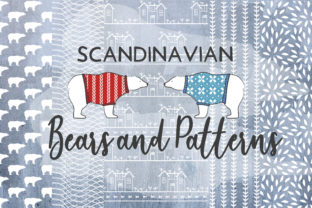
Polar Bears and Patterns is a curated digital design resource built around a cohesive Scandinavian visual language. At its core is a stylized white polar bear—clean, friendly, and minimalist—wearing a warm, textured pullover. This central character anchors a system of 46 individual vector and raster assets, including outline and filled bears, color-varied iterations, and 16 repeatable seamless patterns. The collection supports practical creative workflows, especially for designers working with Nordic-inspired themes in textile, stationery, packaging, or souvenir production.
What’s Included and How It’s Structured
The package delivers 18 vector files (AI CC and EPS10 formats), ensuring scalability without quality loss. These contain all base elements: one outline bear, one solid white bear, 14 uniquely patterned red pullovers, and 14 matching blue pullovers—each bear distinct in pullover motif but consistent in proportion and posture. The 12 simple geometric patterns—composed of lines, dots, triangles, branches, and subtle organic strokes—are provided in white on transparent backgrounds. Four additional patterns integrate the bear motif itself, reinforcing thematic continuity. All 46 PNGs are 1450 pixels on the longest side, at 300 dpi, with full transparency. Preview JPGs offer quick visual reference.
Why Designers Consider This Collection
Designers often seek assets that balance authenticity with flexibility—especially when developing products aligned with Nordic aesthetics. Polar Bears and Patterns offers a ready-made visual vocabulary rooted in Scandinavian design principles: restraint, functionality, and quiet warmth. Its appeal lies not in novelty alone, but in coherence: every bear shares proportional harmony; every pattern scales cleanly; colors are limited to white, red, and blue—tones historically associated with Nordic national flags and regional craft traditions.
Users commonly evaluate this set for projects where thematic consistency matters—such as limited-edition apparel, gift shop merchandise, or interior textile lines. Because the bears and patterns are modular, they support both standalone use (e.g., a single bear on a mug) and layered composition (e.g., a bear placed over a branch-patterned background). The inclusion of both red and blue pullovers allows for palette variation without introducing new hues—helpful when maintaining brand color discipline.
Practical Benefits and Realistic Tradeoffs
A key benefit is time efficiency. Creating 28 uniquely patterned bears from scratch—including consistent linework, balanced negative space, and scalable vectors—requires significant illustration skill and iteration time. Polar Bears and Patterns provides these pre-vetted, production-ready assets. The seamless patterns are tile-optimized, reducing manual tiling effort in layout software. The transparent PNGs simplify integration into mockups or print templates.
However, users should consider tradeoffs. The collection intentionally avoids gradients, shadows, or texture overlays—prioritizing flat, print-friendly forms. That makes it less suited for designs requiring dimensional realism or high-contrast drama. Similarly, the limited color palette (white, red, blue) supports cohesion but may constrain projects needing broader chromatic range. Users seeking photorealistic wildlife art or highly detailed naturalism will find this set too stylized.
Another consideration is licensing scope. While the files support commercial use (e.g., printed textiles or physical souvenirs), the set does not include extended rights for resale as standalone digital assets (e.g., selling the vector bears as clipart). Users intending redistribution should verify license terms separately.
Situations Where This Collection Fits Well
This resource aligns strongly with specific creative goals. It is especially effective for designers developing Nordic-themed product lines—think woolen throws, ceramic tableware, or illustrated postcards for travel retailers. Its clean vector structure also suits screen-printing and embroidery digitization, where simplified shapes and clear outlines translate reliably to fabric and thread.
Small studios or independent makers benefit from the modularity: combining a blue-pullover bear with a geometric line pattern creates an instant textile repeat; overlaying a white bear on a branch motif yields a subtle wallpaper design. Educators teaching pattern design or vector illustration may also find value in the set’s clarity—it demonstrates repetition, variation, and motif hierarchy without visual noise.
When Alternatives May Be More Appropriate
If a project demands cultural specificity beyond general Nordic cues—such as Sámi duodji motifs, Faroese knitting symbols, or Icelandic folklore references—this collection does not provide those narratives. Its aesthetic is broadly Scandinavian rather than regionally precise.
Similarly, designers building fully custom brand systems may prefer commissioning original illustrations. While Polar Bears and Patterns offers consistency, it does not allow for bespoke anatomy, expression, or narrative context beyond what’s supplied. Projects requiring animation, 3D modeling, or responsive web patterns (e.g., CSS repeats) would need adaptation beyond the included static files.
For users focused exclusively on photographic or painterly styles—or those needing large-scale mural graphics—the 1450-pixel PNG resolution may require upscaling, which can affect crispness in very large-format outputs. In such cases, higher-resolution raster libraries or custom illustration may be preferable.
Making an Informed Choice
Evaluating Polar Bears and Patterns comes down to alignment with three criteria: aesthetic direction, technical needs, and production context. Ask yourself:
- Does your project call for a warm, minimal, nature-adjacent Nordic tone—not literal Arctic documentation, but evocative suggestion?
- Do you need scalable, print-ready vectors and seamless repeats—rather than editable source layers or multi-layered PSDs?
- Will the red/blue/white palette and bear-centric motif support, rather than limit, your end use—whether that’s woven fabric, laser-cut wood signs, or seasonal greeting cards?
If the answers trend toward yes, the collection offers efficient, stylistically grounded utility. If your work requires greater chromatic range, narrative depth, or technical flexibility (e.g., variable fonts, animated SVGs), exploring custom illustration or broader pattern libraries may better serve long-term goals.
Ultimately, Polar Bears and Patterns functions as a focused toolkit—not a universal solution, but a considered starting point for designers who value clarity, cohesion, and quiet intention in their Nordic-inspired work.