Seamless Patterns - CF-Kit-619-004
If you've ever spent 20 minutes trying to tile a background in Photoshop only to spot a visible seam—or worse, discovered the pattern breaks at mobile breakpoints—you know how much time and frustration poorly constructed repeats can cost. Seamless Patterns - CF-Kit-619-004 solves that problem at the source: it delivers 300×300 pixel PNG tiles engineered for true visual continuity, with zero manual editing required.
What Makes These Tiles Actually Seamless?
Not all “seamless” patterns behave the same way. Many rely on soft edges or subtle gradients to mask joins—fine for low-res web use, but unreliable when scaled, rotated, or layered. Seamless Patterns - CF-Kit-619-004 uses precise edge-matching logic: every tile’s left edge aligns perfectly with its right, and its top matches its bottom—mathematically, not just visually. That means you can repeat them infinitely in CSS (background-repeat: repeat;), Illustrator’s Pattern Options, or Figma’s auto-layout grids—and trust what you see at 100% zoom is what ships to users.
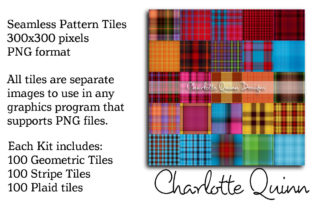
Each kit contains three distinct, non-overlapping categories: 100 geometric tiles (think tessellated hexagons, interlocking triangles, and modular grids), 100 stripe variants (thin, wide, diagonal, offset, and variable-weight), and 100 plaid interpretations (from classic tartan ratios to asymmetrical, color-shifted weaves). All are delivered as individual PNG files—no ZIP extraction gymnastics, no embedded layers, no locked assets. Just drag, drop, and repeat.
Why Designers & Developers Reach for This Kit First
It’s not about having more patterns—it’s about having the right ones, ready to deploy. Unlike generative tools that produce unpredictable outputs, Seamless Patterns - CF-Kit-619-004 gives you full visual control *before* implementation. You’re not sampling randomness; you’re selecting from a curated, tested set where contrast, scale, and rhythm were considered deliberately.
For example: A freelance educator building an interactive math workbook might use a subtle triangular grid tile as a light background layer—clean enough to support text legibility, structured enough to reinforce geometry concepts. A Shopify store owner launching a capsule clothing line could apply a narrow charcoal-and-cream stripe tile to product cards, reinforcing brand consistency without custom coding. A nonprofit communications team might overlay a low-opacity plaid tile on a campaign landing page to add texture while preserving accessibility contrast ratios.
Real-World Use Cases Across Roles
- UI/UX designers: Apply stripe tiles as subtle hover states or disabled-field backgrounds—no need to generate new CSS gradients for each variant.
- Marketing teams: Drop plaid tiles into Canva templates for social banners or email headers; they scale cleanly across devices and render reliably in Outlook and Gmail.
- Educators & trainers: Use geometric tiles as printable worksheet borders or slide deck textures—print-safe at 300 DPI and compatible with Google Slides’ native image upload.
- Print-on-demand creators: Import tiles directly into Printful or Gelato’s mockup editors; the 300×300 size fits standard textile repeat requirements without resampling artifacts.
- Developers maintaining legacy systems: Reference individual PNG URLs in static site generators—no JavaScript dependencies, no CORS issues, no SVG rendering inconsistencies across older browsers.
Efficiency Gains You’ll Notice Immediately
Time saved isn’t theoretical here. One UX writer reported cutting background asset prep for a 12-page SaaS dashboard from 3.5 hours to 22 minutes after switching to Seamless Patterns - CF-Kit-619-004. Why? Because there’s no trial-and-error alignment, no exporting multiple sizes, no reworking when a client requests “slightly less busy.” You preview, pick, and paste—then move on to higher-value work.
There’s also a quiet productivity boost in cognitive load reduction. When your toolkit removes repetitive decisions (“Should this stripe be 2px or 3px? Does this plaid read as ‘heritage’ or ‘industrial’?”), you preserve mental bandwidth for strategic choices—like how that pattern supports your content hierarchy or reinforces your tone of voice.
Practical Considerations Before You Start
These tiles shine brightest when used intentionally—not as filler, but as functional design elements. Avoid over-layering: stacking three seamless patterns rarely improves clarity. Instead, try pairing one tile with generous whitespace or a single accent color. Also, test contrast early: some geometric tiles with fine lines may fade against light grays on low-brightness screens. Preview at 150% zoom and in grayscale mode to catch legibility hiccups before handoff.
Remember—they’re 300×300 PNGs, not vector files. That’s deliberate: PNG ensures pixel-perfect fidelity across platforms and avoids SVG rendering quirks in email clients or CMS WYSIWYG editors. If you need scalable vectors for logos or icons, look elsewhere—but for backgrounds, overlays, and textures, raster precision beats theoretical scalability every time.
Where This Fits in Your Creative Workflow
Think of Seamless Patterns - CF-Kit-619-004 as your reliable utility player—not the star of the show, but the one who consistently makes everyone else look better. It integrates smoothly whether you’re working solo in Affinity Designer, collaborating in Figma, prepping assets for WordPress themes, or building static HTML prototypes. No plugin installs. No learning curve. No vendor lock-in.
You’ll reach for it when deadlines tighten, when stakeholders ask for “something clean but not boring,” or when you simply want to spend less time fixing seams and more time refining messaging, interaction, or storytelling. And because each tile is discrete and named logically (e.g., geom-47-triangular-offset, plaid-88-navy-ecru-12pt), version control and team handoffs stay frictionless.
In short: if your work involves visual communication—even occasionally—Seamless Patterns - CF-Kit-619-004 earns its place in your asset library not by being flashy, but by being dependable, precise, and quietly powerful.