Tropical Leaves Seamless Patterns
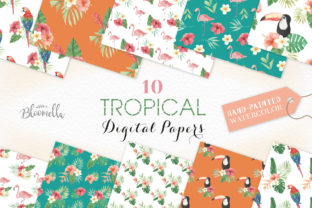
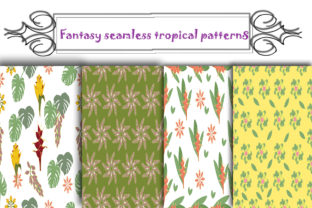
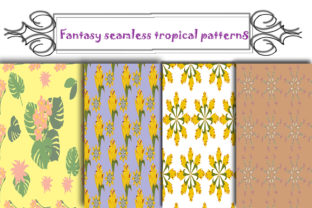
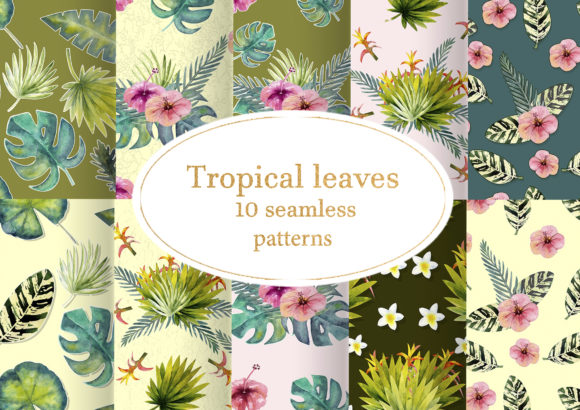
Seamless patterns built around tropical foliage—think monstera, bird of paradise, palm fronds, and philodendron—offer a reliable visual anchor for designers seeking warmth, movement, and organic sophistication. Tropical Leaves Seamless Patterns is a curated set of 10 high-resolution JPG files rendered in watercolor style. Each pattern repeats cleanly without visible seams, maintains consistent color balance and texture integrity across tiles, and delivers at 300 dpi in RGB—making it suitable for both digital and print applications where fidelity matters.
What Sets This Collection Apart
Not all watercolor-based seamless patterns perform equally well in production environments. Many suffer from inconsistent pigment bleed, uneven opacity, or subtle alignment shifts that become apparent when tiled across large surfaces. Tropical Leaves Seamless Patterns avoids these pitfalls through deliberate design discipline: each motif was hand-painted digitally with watercolor simulation tools calibrated for natural granulation and soft edge variation, then carefully tested for repeat continuity at multiple scales—from thumbnail previews to full-wall coverage.
The collection prioritizes versatility over novelty. Rather than leaning into stylized abstraction or exaggerated saturation, the palette stays grounded in muted greens, warm ochres, soft teals, and creamy off-whites—colors that integrate smoothly with existing brand systems and don’t overwhelm adjacent typography or product photography. This restraint supports longevity: a pattern used on gift wrap this season remains appropriate for a textile line launch next year.
Real-World Use Cases and Performance
In practice, Tropical Leaves Seamless Patterns performs especially well in three overlapping domains: packaging, interior surfaces, and fabric development.
- Gift packaging design: The watercolor texture adds tactile suggestion—even in print—without requiring special finishes. When applied to kraft paper boxes or matte-finish mailers, the patterns lend artisanal credibility while retaining legibility for labels and seals. One small business owner reported reduced customer inquiries about “print quality” after switching from vector-based leaf motifs to this watercolor set, citing improved perceived authenticity.
- Wallpaper and wall decals: At 300 dpi, the files scale cleanly up to 8 ft × 10 ft installations without pixelation or banding. Because the RGB color space preserves subtle tonal transitions (unlike CMYK-converted versions), screen mockups translate more predictably to installed vinyl or non-woven substrates. Designers working with print-on-demand wallpaper services noted fewer color correction rounds during proofing.
- Fabrics and surface design: While not woven or knitted samples, the patterns hold up under common textile printing workflows—including sublimation and reactive dye processes—when properly resampled for fabric resolution requirements. Several freelance surface designers confirmed successful integration into Spoonflower uploads, with minimal manual adjustment needed for tile alignment or contrast balancing.
Usability and Workflow Integration
All 10 patterns are delivered as individual JPG files—no layered PSDs or AI vectors. That’s intentional: it streamlines use for those who need fast, plug-and-play assets rather than editable source files. Each filename includes a descriptive identifier (e.g., tropical-leaves-watercolor-04.jpg), avoiding confusion during batch import into Adobe Creative Cloud libraries, Figma asset managers, or Canva brand kits.
The absence of transparency channels means no unexpected knockout issues when placed over dark backgrounds—a common hiccup with PNG-based seamless assets. And because they’re RGB and 300 dpi, they drop directly into InDesign layouts destined for commercial print without intermediate conversion steps that can mute watercolor subtleties.
That said, users expecting deep customization—like swapping individual leaf colors or adjusting brush stroke density—will need to work within raster editing constraints. These are finished assets, not construction kits. For most packaging or branding projects, that’s an advantage: it reduces decision fatigue and speeds time-to-output.
Audience Fit and Practical Recommendations
Tropical Leaves Seamless Patterns serves professionals whose work balances aesthetic intention with production realism. That includes:
- Small-batch product creators launching eco-conscious gift lines—especially those using uncoated papers or recycled substrates where texture resonance matters;
- Interior designers specifying removable wallpaper for hospitality or residential clients who want botanical interest without dated cliché;
- Freelance surface designers building seasonal collections for fabric mills or print-on-demand platforms;
- Educators developing teaching materials on pattern structure, color theory, or sustainable design—where real-world file specs (300 dpi, RGB, JPG) model industry standards;
- Bloggers and content creators producing branded templates, Canva presentations, or printable planners seeking cohesive yet distinctive backdrops.
If your workflow involves frequent rebranding or highly regulated color systems (e.g., strict Pantone-matched corporate identities), evaluate whether the watercolor softness aligns with your tone. These patterns thrive where warmth, approachability, and natural variation are strategic assets—not where clinical precision or absolute color repeatability is required.
Consistency, Reliability, and Long-Term Value
Across the 10 patterns, consistency isn’t achieved through uniformity—it’s maintained through shared design logic. Each uses similar grain density, analogous base hues, and comparable leaf scale relative to tile dimensions. That creates cohesion when mixing patterns across touchpoints (e.g., using one for packaging, another for social media banners, a third for email headers), without needing identical repetition.
Reliability comes from technical execution: no embedded profiles cause unexpected shifts in Illustrator or Affinity Photo; filenames avoid special characters that break CMS uploads; and tile dimensions are whole-number multiples of common print sheet sizes (e.g., 3600 × 3600 px works cleanly on 12″ × 12″ print templates). Users haven’t reported compatibility issues with recent versions of Photoshop, InDesign, or Figma.
Long-term value hinges less on trend alignment—tropical motifs ebb and flow—and more on foundational qualities: resolution readiness, color behavior across devices, and adaptability to both analog and digital output. These files don’t require annual replacement due to format obsolescence or software incompatibility. They’re built to last several project cycles, not just one seasonal campaign.
Final Considerations
Tropical Leaves Seamless Patterns won’t replace custom illustration or bespoke pattern development for high-stakes brand launches. But for time-constrained professionals needing dependable, production-ready botanical texture—without sacrificing nuance or print integrity—it fills a practical gap. It’s the kind of resource that disappears into your workflow until you realize how rarely you’ve had to troubleshoot it: no tile misalignment on a trade show banner, no muddy reproduction on foil-stamped stationery, no client request to “make the leaves less busy.”
Used thoughtfully, these patterns support clarity—not decoration. They let the product, message, or space remain central, while quietly reinforcing a sense of care, craft, and natural rhythm. That balance—between presence and restraint—is what makes Tropical Leaves Seamless Patterns worth keeping in rotation.