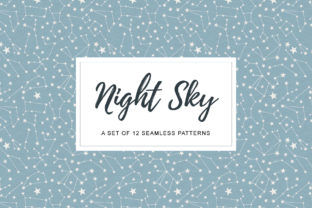
Night Sky Patterns: A Practical Resource for Designers, Educators, and Stargazers
Whether you're crafting a celestial-themed branding package, illustrating an astronomy textbook, or designing immersive planetarium projections, Night Sky Patterns deliver more than just visual appeal—they offer precision, versatility, and immediate usability. This curated collection isn’t a generic starburst overlay or a stylized constellation doodle. It’s a thoughtfully assembled archive built for real-world application—backed by 12 meticulously crafted vector EPS10 files, matched with high-resolution PNG and JPG versions, plus a bonus pattern that expands creative flexibility.
Why Vector Precision Matters in Celestial Design
At the core of this collection lies its foundation in EPS10 vector format. Unlike raster images—which blur or pixelate when scaled—vector files retain crisp, clean lines at any size. That means a single Night Sky Pattern can scale from a tiny app icon (32×32 px) to a 20-foot museum wall mural without losing fidelity. Designers working across branding, packaging, web UI, or large-format print consistently choose vectors for this reason—and these files are optimized for Adobe Illustrator, CorelDRAW, Affinity Designer, and other professional tools.
Each of the 12 patterns represents a distinct celestial arrangement: Orion’s Belt with subtle nebula gradients, the Pleiades cluster rendered in soft radial symmetry, Ursa Major’s angular confidence, Cygnus’s elegant cross shape, and more. They’re not just outlines—they’re balanced compositions, with intentional negative space, proportional star weights, and calibrated opacity layers that suggest depth and atmosphere.
Format Flexibility: When to Use PNG vs. JPG vs. EPS
Having all three formats—EPS, PNG, and JPG—for each pattern isn’t redundancy. It’s responsiveness to workflow reality.
- PNG files include transparent backgrounds—ideal for web banners, social media overlays, digital presentations, or layered mockups where the pattern needs to sit cleanly over photos, gradients, or textured backgrounds.
- JPG files offer smaller file sizes and universal compatibility—perfect for quick client previews, email attachments, CMS uploads, or situations where transparency isn’t required but fast loading is.
- EPS10 files remain the gold standard for editing, scaling, and integration into complex layouts—especially in editorial design, signage production, or multi-platform brand systems where consistency across mediums is non-negotiable.
This tri-format approach eliminates the need to convert, compress, or re-export manually—saving hours over the course of a project. For educators building interactive astronomy slides, it means dragging a PNG directly into PowerPoint without background cleanup. For textile designers printing on fabric, it means opening the EPS in Illustrator, adjusting stroke width for thread count, and exporting seamlessly to embroidery software.
Beyond Aesthetics: How Night Sky Patterns Support Real Learning & Engagement
Visual literacy in astronomy starts with accurate, recognizable references—and Night Sky Patterns support that intuitively. The patterns avoid cartoonish exaggeration while remaining legible at a glance. That balance makes them especially effective in educational contexts: classroom posters, student handouts, AR app assets, or even tactile learning kits (when printed on textured paper or vinyl).
One educator in Arizona uses the Cassiopeia pattern as a base layer in a rotating star chart activity—students align it with seasonal sky maps and annotate visible planets. A children’s book illustrator in Edinburgh layered the Scorpius pattern beneath hand-drawn ink work to anchor the composition in real celestial geometry—not fantasy. These aren’t decorative flourishes; they’re functional scaffolds for understanding spatial relationships, seasonal shifts, and navigational logic.
Modern Applications Across Industries
The utility of Night Sky Patterns extends well beyond traditional design studios and classrooms.
Architecture & Interior Design
Firms integrating biophilic principles into wellness-focused spaces use these patterns for laser-cut ceiling panels, backlit wall features, or etched glass partitions. The Lyra pattern—clean, geometric, and subtly asymmetrical—has been adapted into modular tile layouts for meditation rooms and hospital lobbies, where its quiet rhythm supports calm without visual clutter.
Fashion & Textile Development
From silk scarves with delicate Ursa Minor repeats to sportswear fabrics featuring high-contrast Andromeda motifs, designers appreciate how easily these vectors integrate into repeat swatches. Because each pattern is built on a seamless, tileable grid (with clear repeat boundaries marked in the EPS layers), scaling into fabric prints takes minutes—not days.
Digital Experiences & Motion Graphics
Animators use the individual star elements—grouped logically in layers—as starting points for particle simulations. One motion designer in Berlin imported the Taurus pattern into After Effects, animated star opacity over time to simulate atmospheric distortion, then composited it over live footage of a desert night sky. The result? A documentary sequence that felt both scientifically grounded and emotionally resonant.
What Sets These Patterns Apart From Free Alternatives?
You’ll find countless “free star SVGs” online—but most lack intentionality. They’re often oversimplified, misaligned with actual stellar magnitudes, or built on inconsistent grids. Others are overdesigned: overly ornate, with unnecessary flourishes that limit adaptability.
Night Sky Patterns were developed with three non-negotiable criteria:
- Astronomical coherence: Star placement reflects relative brightness and angular distance (within illustrative tolerance), supporting recognition—not just decoration.
- Production-readiness: All files are pre-tested in common output environments—no missing fonts, embedded raster artifacts, or stray anchor points.
- Design neutrality: No forced color schemes, no rigid stylistic constraints. Each pattern works equally well in monochrome, duotone, metallic foil, or full RGB—because context determines color, not the asset itself.
That neutrality is why one user applied the same Draco pattern across four distinct projects in six months: a black-and-white wedding invitation suite, a navy-and-gold university observatory brochure, a grayscale laser-engraved wooden plaque, and a vibrant Instagram carousel about light pollution reduction.
The Bonus Pattern: Unexpected Utility
The included bonus pattern isn’t an afterthought—it’s a strategic addition. Designed as a subtle, low-contrast field of faint stars (magnitude 5–6), it functions as a versatile backdrop layer. Unlike the 12 named constellations, this one avoids strong directional cues, making it ideal for:
- Creating depth behind headline text in presentations
- Adding texture to dark-mode UI components without competing visually
- Serving as a base for custom constellation mapping—users can highlight specific stars with overlays or annotations
- Printing on translucent vellum for layered lighting effects
It bridges the gap between bold statement and quiet ambiance—a reminder that sometimes the most powerful design choices are the ones you barely notice.
Making the Most of Your Collection
Start small. Import one EPS file into your current project—not to “use it,” but to explore its structure. Unhide layers. Notice how stars are grouped by magnitude. Try recoloring a single layer using global swatches. Then export a PNG at three different sizes and test them in context: on mobile, on desktop, and printed at 150 dpi.
Bookmark the JPG versions for rapid prototyping. Keep the PNGs handy for client-facing decks. Reserve the EPS files for final delivery and archival—knowing they’ll remain editable years from now, even as software evolves.
And don’t overlook metadata. Each file includes embedded naming conventions (e.g., “NightSky_Pattern-07_UrsaMajor_EPS10”)—a small detail that pays off during asset management audits, team handoffs, or licensing reviews.
Ultimately, Night Sky Patterns succeed because they meet people where they are: whether you’re sketching ideas on a napkin or finalizing a multimillion-dollar exhibition install. They don’t ask you to adapt to them. They adapt—with clarity, consistency, and quiet confidence—to whatever comes next.