Mastering Line Patterns: 100 Seamless Vector Designs for Designers, Educators & Creators
What Are Line Patterns — and Why Do They Matter?
Line patterns are visual arrangements composed exclusively—or predominantly—of lines: straight, curved, angled, dashed, or dotted. Unlike complex illustrations or photorealistic textures, line patterns rely on rhythm, repetition, spacing, and direction to create structure, movement, and mood. They’re foundational in graphic design, textile creation, architectural drafting, UI/UX interfaces, and even data visualization.
At their core, line patterns serve two essential functions: organization and expression. A subtle grid of fine horizontal lines can guide the eye across a webpage layout; bold intersecting diagonals might convey energy in a branding campaign; evenly spaced concentric circles can evoke calm focus in an educational worksheet. Their simplicity is deceptive—thoughtful line patterning requires precision, intention, and deep visual literacy.
The Power of Seamlessness in Modern Design
A “seamless” pattern repeats infinitely without visible breaks or misaligned edges. When tiled across a surface—be it a website background, fabric print, packaging wrap, or presentation slide—it creates continuity and professionalism. This quality is non-negotiable for scalable digital assets and production-ready print files.
Seamless line patterns are especially valuable because they’re lightweight, versatile, and adaptable. Unlike raster-based textures (e.g., high-res JPEGs), vector-based line patterns retain crispness at any size—from a tiny app icon to a 20-foot trade show banner. That’s why professionals prioritize formats like .ai (Adobe Illustrator native), .pat (Photoshop pattern swatches), and high-resolution .png (for quick web use or non-Adobe workflows).
Why These Three Formats? A Practical Breakdown
- .ai files: Fully editable vectors with layers, paths, and anchor points—ideal for customizing stroke weight, color, or alignment before final output.
- .pat files: Ready-to-load swatches in Photoshop and compatible tools—perfect for rapid prototyping, mockups, or texture overlays in photo editing.
- .png files: Transparent-background raster versions at 300+ DPI—great for immediate use in Canva, PowerPoint, Figma, or social media graphics where vector support is limited.
How Line Patterns Fit Into Real-World Workflows
From classrooms to corporate boardrooms, line patterns quietly enhance clarity and engagement:
In Education & Learning Materials
Teachers use subtle line grids as writing guides for young learners. Dotted or dashed baseline patterns help students maintain consistent letter height and spacing. In STEM education, isometric or hexagonal line patterns scaffold spatial reasoning and geometry lessons—turning abstract concepts into tactile, visual experiences.
In Branding & Marketing
Minimalist brands often build identity systems around custom line motifs: think of a tech startup using parallel vertical lines to suggest speed and connectivity, or a wellness brand employing soft wavy lines to imply flow and balance. Because line patterns scale effortlessly, they unify everything from business cards to billboards without losing fidelity.
In Digital Product Design
UI designers apply low-opacity line patterns as background textures behind cards or modals—adding depth without competing with content. A delicate diagonal hatch, for example, introduces visual interest while preserving readability and accessibility contrast ratios. These patterns also reduce perceived loading time: small .png files load faster than heavy image backgrounds.
In Print & Packaging
Because vector line patterns are resolution-independent, they’re ideal for luxury packaging, stationery, and labels. A gold foil–printed geometric line border on a cosmetic box retains sharpness whether embossed at 2 mm or scaled to wrap an entire gift box. No pixelation. No reworking.
Common Misconceptions—Clarified
Misconception #1: “All line patterns look sterile or clinical.”
Not true. Line patterns span expressive ranges—from the warmth of hand-drawn ink strokes (digitally traced and vectorized) to the organic irregularity of algorithmically generated wobbly lines. Texture, variation in stroke width, and strategic imperfection bring humanity to line-based design.
Misconception #2: “If it’s simple, it must be easy to create well.”
Simplicity demands rigor. A single-pixel misalignment in a seamless tile causes visible seams at scale. Uneven spacing between parallel lines creates optical vibration. Professional-grade line patterns undergo meticulous testing across multiple tile sizes and color modes (RGB, CMYK, grayscale) to ensure universal reliability.
Misconception #3: “I only need one format—I’ll just convert later.”
Converting between formats sacrifices fidelity. Rasterizing a vector (.ai → .png) loses editability. Converting a .png back to vector (.png → .ai) requires manual tracing or AI upscaling—both introduce inaccuracies. Starting with purpose-built, production-ready files saves hours and preserves creative control.
Introducing: 100 Seamless Vector Line Patterns
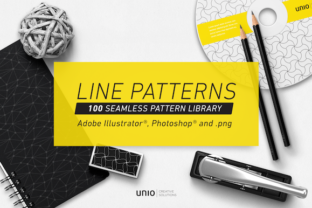
This curated collection isn’t just quantity—it’s intelligent variety. Each of the 100 seamless line patterns is built for real-world application and organized into intuitive categories:
- Geometric Foundations: Grids, triangles, diamonds, chevrons, and tessellated polygons
- Organic Flow: Waves, spirals, gentle curves, branching lines, and biomorphic loops
- Technical Precision: Isometric guides, engineering crosshatches, circuit-board traces, and measurement scales
- Expressive Marks: Stippled rhythms, gestural scribbles, dashed pulses, and variable-weight calligraphic strokes
- Minimalist Textures: Subtle noise-like dots, ultra-thin grids, and barely-there halftones
Every pattern is delivered in all three formats—.ai, .pat, and .png—with consistent naming, embedded metadata, and documentation on recommended use cases. Whether you’re designing a kindergarten workbook, launching a SaaS dashboard, or developing a fashion line, this set provides plug-and-play versatility backed by professional craftsmanship.
Who Benefits Most From These Patterns?
- Graphic Designers: Speed up client projects with production-ready, brand-aligned textures.
- Educators & Instructional Designers: Create accessible, visually structured learning aids in minutes—not hours.
- UI/UX Professionals: Enhance interface hierarchy and micro-interactions with lightweight, performant assets.
- Print & Packaging Specialists: Ensure flawless reproduction across substrates—from matte paper to metallic foils.
- Students & Hobbyists: Learn vector construction principles by studying editable .ai files and reverse-engineering techniques.
Getting Started: Tips for Using Line Patterns Effectively
Even powerful tools require smart application. Here’s how to maximize impact:
- Start with intent: Ask, “What feeling or function should this pattern support?” Calm? Clarity? Energy? Structure?
- Test at scale: Tile your pattern across a large artboard (e.g., 2000×2000 px) and zoom out—look for alignment hiccups or rhythmic inconsistencies.
- Respect contrast: Ensure line weight and color provide sufficient legibility against backgrounds—especially for text overlays.
- Layer thoughtfully: Combine a subtle base grid (.png at 5% opacity) with a bolder foreground motif (.ai overlay) for dimensional richness.
- License wisely: Verify commercial usage rights. These 100 patterns include full perpetual licenses for personal and client work—no attribution required.
Final Thought: Lines Are More Than Decoration
Lines are the original language of human expression—from cave wall etchings to neural pathways mapped in MRI scans. Line patterns distill that primal communication into functional, beautiful tools. They don’t shout; they guide. They don’t overwhelm; they organize. And when built with care—as these 100 seamless vector patterns are—they become silent collaborators in every project you undertake.
Whether you're sketching your first wireframe or refining a global brand system, remember: the most powerful designs often begin with a single, intentional line.