Rope Patterns - Small Pack
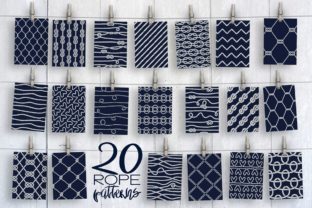
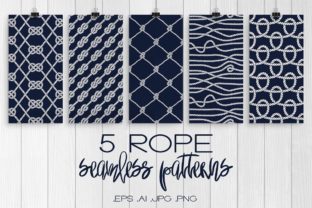
If you're building a nautical brand, designing coastal apparel, or crafting marine-themed printables — the Rope Patterns - Small Pack is one of those quiet, high-impact resources that saves hours while elevating your visuals. It’s not just another set of textures. It’s five carefully engineered rope-based patterns — fishnets, loops, knots, and woven motifs — all built from real-world nautical references and refined for seamless digital and physical use.
What Makes These Rope Patterns Stand Out
These aren’t stylized illustrations or loosely interpreted doodles. Each pattern in the Rope Patterns - Small Pack was developed with intention: consistent scale, authentic rope thickness, natural tension in knots, and subtle texture variation that mimics how hemp, nylon, or polypropylene rope behaves under light and stretch. The marine palette centers on deep navy — rich enough to ground bold typography, versatile enough to pair with crisp whites, sandy beiges, or coral accents.
Every design scales cleanly from business cards to billboard-sized backdrops. That’s because they’re delivered in native vector formats (.AI and .EPS10) alongside high-res raster files — including 5 PNGs with transparent backgrounds (5000×5000 px, 300 dpi) and 5 JPGs on dark blue (same dimensions and resolution). No upscaling. No pixelation. Just plug-and-play precision.
Where These Patterns Actually Get Used — Beyond the Obvious
Yes, they work beautifully on t-shirts, tote bags, and beach towels — but their real value shines in less obvious places:
- Brand identity systems: Use the fishnet pattern as a subtle watermark behind product photography, or layer a knot motif into a logo’s negative space for depth and narrative.
- Educational materials: Marine biology teachers embed the loop pattern into worksheets about buoyancy or knot-tying techniques — making abstract concepts tactile and visually anchored.
- Digital interfaces: Designers apply the rope loop pattern as a soft background for dashboard cards in sailing apps or port management tools — reinforcing context without competing with data.
- Packaging & gift wrap: The seamless nature means no visible repeats on cylindrical jars or long ribbon rolls — critical when wrapping artisanal sea salt, coastal candles, or small-batch rum.
- Print-on-demand workflows: Because each file is pre-sized at 5000×5000 px and 300 dpi, they drop directly into platforms like Printful or Gelato without resizing, color profile shifts, or bleed adjustments.
Why Seamlessness Matters More Than You Think
A “seamless” pattern isn’t just about aesthetics — it’s about usability. When a repeat edge doesn’t match, your fabric supplier may flag it for correction. A mismatched tile in web design creates visual noise that distracts from messaging. In packaging, even a 2-pixel seam misalignment can cause registration errors during printing.
The Rope Patterns - Small Pack eliminates that risk. Each pattern was tested across multiple tile sizes and output methods — from inkjet proofing to rotary screen printing — ensuring alignment holds whether you’re printing on cotton twill or laminated vinyl. That consistency translates directly into fewer revisions, faster approvals, and more confident client presentations.
Realistic Tips for Getting the Most From This Pack
You don’t need to be a vector expert to use these — but a few practical habits help you go further:
- Start with the EPS10 files if you’re using older Adobe versions — they retain full editability in Illustrator CS6 and newer, unlike some AI-native features that won’t downgrade gracefully.
- Use the transparent PNGs for layered mockups — especially when placing designs over watercolor backgrounds or textured paper scans. The clean alpha channel preserves soft edges without halo artifacts.
- Don’t overlook the dark blue JPGs — they’re ideal for social media banners where contrast and readability are non-negotiable (think Instagram story headers or LinkedIn cover images).
- Test scaling before committing to large-format prints — zoom in at 400% in your layout app. If rope strands stay crisp and evenly spaced, you’re good to go up to 8 feet wide.
- Pair with complementary typefaces — try monospaced sans-serifs (like IBM Plex Mono) or sturdy serifs (like Tiempos Headline) to balance the organic texture of the rope without visual competition.
Who Benefits Most — And Why
This pack resonates strongest with creators who understand that texture tells part of the story. A surf school launching a new merch line doesn’t just need “blue stuff” — they need visual shorthand that says *resilience*, *motion*, and *connection to the sea*. A boutique stationery brand sourcing eco-friendly kraft paper uses the knot pattern not as decoration, but as a quiet nod to craftsmanship and sustainability.
Freelancers appreciate the time saved — no hunting through inconsistent free resources or paying for oversized bundles with only one usable design. Educators use them to build cohesive classroom kits that feel professionally produced, even on tight budgets. Small studios building pitch decks for coastal municipalities find that including these patterns in mood boards signals attention to regional authenticity — not just generic “ocean vibes.”
A Final Note on Intentional Design
There’s a difference between using a pattern to fill space and using it to reinforce meaning. The Rope Patterns - Small Pack works because every element serves a functional and symbolic purpose: fishnets suggest connection and capture; loops imply continuity and utility; knots speak to skill, security, and tradition. When those motifs appear in your work, they do more than look good — they quietly align your visuals with your values.
That kind of cohesion doesn’t happen by accident. It happens when you choose assets built with craft, tested in real production environments, and delivered with clarity — not clutter. Whether you’re sketching on paper or exporting final files for print, this pack gives you room to focus on what matters most: your idea, your audience, and the story you’re telling.